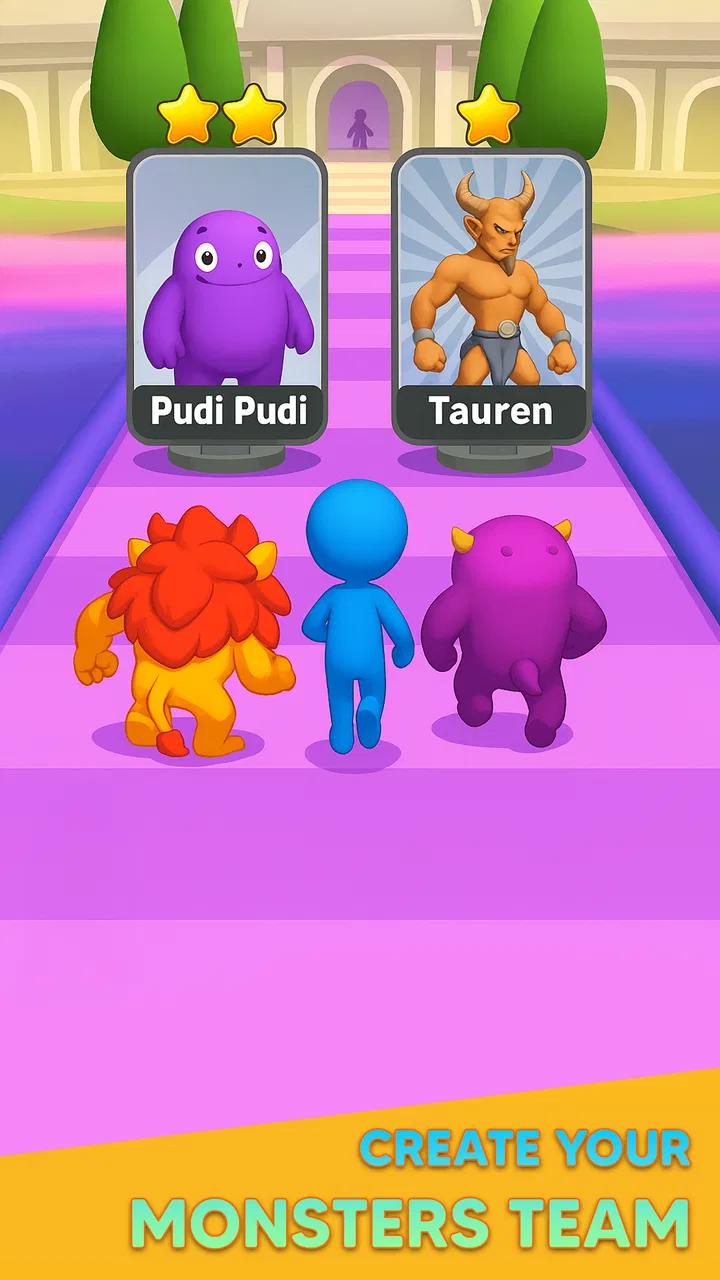
Monster Draft : Merge Runner
- 4.8
- Rating
- 50.00M
- Installs
- Free
- Price

 Analysis by App-foxy
I approached Monster Draft: Merge Runner expecting a quick action game built around collecting and combining creatures, and that is exactly where its appeal lies. The basic idea is easy to understand: gather monster cards, merge monsters, and use the results to take on beasts. What surprised me was how quickly that simple loop creates small decisions. I am not only reacting to what appears in front of me; I am also thinking about which monsters are worth keeping, when a merge is useful, and whether I am building toward a stronger battle or merely clearing space.
That makes this a good fit for short sessions. I can pick it up when I have a few spare minutes, understand the immediate objective without studying a long tutorial, and still feel that each run has a purpose. It is a free action game from Oreon Studios, with optional purchases priced from $0.99 to $19.99 per item. The Teen content rating is worth keeping in mind, especially for younger players and families deciding what belongs on a shared device.
How the early goals turn a simple merge into a playable routine
The opening experience works because the game gives me a clear chain of actions. I collect, I combine, and I prepare for a monster battle. That sequence is more satisfying than simply tapping through enemies because the collection phase affects what happens later. Even before I understand every possibility, I am already watching for useful combinations rather than treating every card as disposable.
You May Also Like

 Blood Strike: 2.5 Anniversary
Blood Strike’s Loadouts Turn Every Drop Into a Tactical Gamble
A close look at Blood Strike’s custom loadouts: how fast access to signature weapons reshapes its battle royale rhythm, rewards preparation, and narrows the gap between fights.

 Pandora - Music & Podcasts
Pandora’s Music Is Easy to Start, but Harder to Recover
Pandora’s strength is its low-effort path from a seed to a station. Its weak spot is how much confidence it asks you to place in connection, setup, and quiet recovery.

 8 Ball Pool
 Is Built on Rivalries, Rematches, and Routine
A close look at the rivalries, rematches, shared routines, and unanswered safety questions that turn a quick pool match into a persistent mobile community.

 Samsung Music
’s Quiet Strength Is Playing What You Already Own
Its reach comes less from spectacle than from dependable access to a personal library. That simplicity is both the app’s strongest retention engine and its ceiling.

 AccuWeather: Weather Radar
AccuWeather Review: A Quick, Clear Forecast for Everyday Decisions
For everyday plans, the best forecast is the one you can understand quickly. AccuWeather makes rain timing, radar, and local conditions easy to act on, with a few trade-offs.

 Hill Climb Racing
Why Hill Climb Racing Still Turns Crashes Into One More Run
A tiny car, a bumpy hill and one more upgrade: Hill Climb Racing keeps resurfacing because its simple chaos makes every near-miss feel personal.
More From Our News Desk



The early goals are not complicated, but they are effective. A new player can focus on making the next merge, improving the current group of monsters, and surviving the next confrontation. I like that the game does not require me to learn a large set of controls before I can enjoy it. The action category is visible in the moment-to-moment pace, while the card and merge elements give the battles a planning layer that a straightforward runner or basic tapping game would not have.
My first practical tip is to avoid merging automatically just because two compatible monsters are available. A merge can solve an immediate problem, but it can also remove useful options from the collection. I found it more rewarding to pause briefly and ask whether the combination improves my battle position or simply makes the screen look tidier. That small habit makes the game feel more strategic without turning it into a slow, complicated card game.
The card collection also gives the early stages a sense of discovery. I am not only chasing a score; I am gradually learning which kinds of monsters feel valuable in my current situation. That is an important distinction. Players who enjoy seeing a collection grow will probably find more motivation here than players who want every stage to be a pure reflex test.
A realistic use case is a short commute or a waiting-room break. I can play a little, stop, and return later without needing to rebuild my understanding from scratch. The loop is compact enough for casual use, yet the merging decision gives me something to think about during each attempt. For me, that balance is more engaging than an action game where every session feels identical.
What the first sessions teach well
The game introduces its central relationship clearly: collecting supports merging, and merging supports the battle against beasts. That connection matters because it prevents the card element from feeling decorative. The cards are part of the reason to pay attention, not just a screen of collectibles placed beside an action mode.
There is also a useful rhythm between preparation and pressure. I have a moment to consider what I am building, followed by a more urgent encounter. The contrast keeps the opening from becoming a single flat stream of taps. If I am playing casually, I can focus on the immediate target. If I am in the mood to optimize, I can think about how the next merge may affect the following encounter.
Still, the simplicity may not satisfy everyone. Someone looking for a deep role-playing system, a long narrative campaign, or a highly technical competitive battle game should set expectations accordingly. This is designed around an accessible action loop, not around extensive character management. Its strength is that I can understand the purpose of a card quickly; its limitation is that the game may feel light to players who want a much larger strategic framework.
Progress signals, unlock motivation, and the value of better decisions
Progress in this game is communicated through the things I can collect, merge, and use against increasingly demanding encounters. Those signals are more meaningful to me than a number that rises without changing how I play. When a new monster or a stronger combination becomes relevant, I feel that my decisions have a visible consequence.
The collection itself acts as a long-term reason to return. Even when a particular run is not especially memorable, the thought of improving the group of cards keeps the next attempt worthwhile. This is a familiar retention technique in mobile games, but here it fits the main mechanic instead of sitting beside it. I am not collecting unrelated rewards; I am collecting material that connects directly to the merge-and-battle loop.
One of the less obvious strengths is that progress can be approached in two ways. I can play for immediate survival, choosing the merge that helps me right now, or I can make a more patient choice that supports a stronger collection later. Those goals are not always identical. The best short-term move may not be the best long-term move, and that tension gives the game more texture than its simple premise suggests.
I recommend treating the collection as a resource rather than a checklist. If I chase every possible card without considering how it fits into a battle, the collection can become visually satisfying but strategically weak. Conversely, if I focus only on the strongest-looking option, I may miss the pleasure of experimenting with different combinations. The most enjoyable approach is to use the collection to test decisions, not merely to complete it.
Players often want to know whether progress feels meaningful without spending money. I found the free entry point suitable for learning the game and deciding whether the loop works for me. Optional purchases are present, so anyone sensitive to spending should establish a personal limit before playing. The important question is not whether purchases exist, but whether the player can enjoy collecting and merging without feeling pushed into buying something after every setback. My experience is that the game is most comfortable when I treat purchases as optional rather than as part of the basic routine.
The current version is 4.0.10, and the game supports devices running Android 7.0 or later. That makes it accessible to people using older compatible Android hardware, although the actual comfort of play will still depend on the device and how smoothly it handles the action. I would check the operating-system requirement before recommending it for an older phone or tablet.
How to read progress without rushing
A useful workflow is to separate collection decisions from battle panic. When the game gives me room to prepare, I look at what I already have and identify the merge that creates the clearest improvement. During the active part, I then concentrate on execution instead of changing plans constantly. This sounds simple, but it prevents me from making hurried combinations that leave the next stage weaker.
I also prefer judging progress by consistency rather than by one lucky run. A powerful result can be exciting, but a repeatable merge strategy tells me more about whether I am actually improving. That is where the game earns some of its replay value: I can return not only to collect more, but to see whether a better decision produces a steadier outcome.
The system will appeal most to players who enjoy incremental improvement. If you like watching a small collection become more useful over time, the goals have enough shape to support repeated sessions. If you need dramatic unlock scenes, a large story, or a constant stream of new mechanics, the progression may feel too restrained.
Difficulty, pacing, and the point where the loop tests patience
The difficulty curve is tied closely to the relationship between preparation and battle. Early play gives me time to understand the merge logic, while later pressure makes poor choices more noticeable. That is a sensible structure because the game does not need to explain every consequence in a long instruction screen; it lets the player learn through the result of a decision.
I appreciate that the challenge is not only about reacting faster. A player who rushes through collection can create problems before the battle even begins. The game therefore rewards attention in two different moments: deciding what to combine and responding when the beasts arrive. This makes the action feel more deliberate than a standard endless run where the main goal is simply to avoid obstacles for as long as possible.
There is a trade-off here. When I make a poor merge, the consequences can feel more frustrating than a simple missed tap because the mistake began earlier. Players who enjoy learning from errors will see that as a reason to try again. Players who want instant restarts with no planning baggage may find it irritating. The difference comes down to whether you enjoy responsibility for the setup as much as the battle itself.
The pacing is strongest when the game moves quickly from a clear preparation choice into a meaningful confrontation. If the collection phase becomes routine, the action can lose some of its impact. I found that varying my attention helped: sometimes I played for a safer result, and sometimes I experimented with a less obvious merge to see how it affected the next encounter. That self-directed variation keeps the loop from feeling completely mechanical.
Compared with a traditional action game, this title asks for less precise control and more resource awareness. Compared with a conventional card battler, it feels more immediate because the merge decisions are connected to active monster encounters rather than being handled entirely through a static turn structure. A pure merge puzzle may offer a calmer experience, while a reflex-focused runner may deliver faster reactions. This game sits between those alternatives, and that middle position is its clearest identity.
I would not choose it for someone who wants a carefully balanced competitive environment where every match depends on advanced deck construction. I would also skip it for a player who dislikes repeating a compact loop in search of a better result. On the other hand, it is a strong option for someone who likes action games but wants a little planning between bursts of pressure.
Where the challenge feels fair and where friction appears
The fair part of the challenge is that the game gives me a chance to influence the outcome before the battle becomes urgent. I am not relying only on reflexes. The friction appears when I am unsure whether a merge is genuinely improving the situation or merely changing the collection. That uncertainty can make a loss feel avoidable, but it can also make the next attempt more interesting because I have a specific decision to reconsider.
My advice is to resist the urge to change everything after one failed run. Instead, identify the earliest decision that created trouble. Was the collection too narrow? Did I merge for convenience? Did I prioritize an immediate improvement over a stronger setup? Focusing on one decision at a time makes the difficulty feel like a learning process instead of random punishment.
That approach also answers a common concern about replay value. The game can sustain play when each return has a small personal objective, such as building a better merge sequence or handling a difficult beast more confidently. It is less compelling if I play without a goal and expect the game itself to provide a completely new experience every few minutes.
Retention pressure and whether returning still feels worthwhile
The main retention pressure comes from the desire to improve the monster collection and see stronger results in battle. That is a reasonable reason to return because it is connected to play rather than being entirely separate from it. I do not need to invent a reason to care about the cards; they are part of the action loop.
At the same time, the game uses a familiar mobile structure in which optional purchases can sit alongside repeated progression. The available items range from $0.99 to $19.99 each, so I would be careful with impulse spending, especially when a difficult encounter makes a shortcut seem attractive. My preferred way to play is to decide in advance whether I am playing for the free collection challenge or whether I am comfortable paying for convenience. Mixing those intentions without a limit can make the pacing feel more pressured than it needs to be.
The game is also widely adopted, with over 50 million installs and an average rating of 4.8 from around 171 thousand ratings. Those figures suggest that the central loop has connected with a large audience, but they do not replace personal testing. A popular game can still be the wrong fit if its pace, collection focus, or purchase structure conflicts with what I want from an action title.
For everyday use, I think the best pattern is controlled repetition. I play until I have completed a small goal, then stop rather than continuing automatically. This keeps the merge decisions fresh and prevents the collection from turning into background tapping. It is especially useful for people who want a lightweight game for breaks but do not want a title that demands a long uninterrupted session.
Parents and guardians should also consider the Teen rating before handing it to a younger child. The game is free to start, but in-app purchases mean that device-level spending controls are sensible for shared phones and tablets. That is not a criticism of the merge system itself; it is practical advice for any family game with optional paid items.
Who gets the most from the replay loop
I would recommend it to players who like collecting monster cards, making quick combinations, and seeing whether those decisions hold up against active threats. It is particularly suitable for someone who wants more thought than a basic runner but less complexity than a full deck-building strategy game.
I would be more cautious recommending it to players who dislike repetition, want a strong narrative, or prefer games with a clearly finite ending. The collection-and-merge structure is designed to encourage another attempt. That can feel satisfying when I am chasing a better result, but it can feel circular when I am not.
The game also works for different moods. In a relaxed session, I can focus on collecting and make safe decisions. In a more engaged session, I can examine the trade-off between immediate strength and future options. That flexibility is one of its better qualities, although the game still depends on the player bringing some of the long-term motivation.
My progression verdict after weighing the whole loop
After spending time with Monster Draft: Merge Runner, I see it as an approachable action game whose strongest idea is the connection between collection, merging, and monster battles. The early goals are clear, progress is visible through the growing usefulness of the cards, and the difficulty gives thoughtful preparation a real purpose. It does not need a complicated ruleset to create decisions.
Its limitations are equally clear. The loop may become repetitive for players who need constant novelty, and the optional purchases can add pressure if I approach progression without a spending boundary. The game is also not a replacement for a deep card battler or a precision-heavy action game. It occupies a narrower space, but it serves that space well.
Oreon Studios has built something that is easy to start and more considered than its short description might suggest. My most useful recommendation is to play deliberately: keep an eye on the collection, do not merge automatically, and use each failed attempt to identify one decision worth changing. That turns the game from a sequence of quick taps into a small but satisfying strategy routine.
With a 4.8 average from roughly 171 thousand ratings and more than 50 million installs, it is clearly not a niche experiment. Still, I would judge it by the kind of session I want. If I want a free action game that combines monster collecting with quick merge decisions and repeated battles, it is easy to recommend. If I want a story-driven adventure, a deep competitive card system, or a completely non-repeating experience, I would choose something else.
For me, the progression verdict is positive with a sensible caveat: the game sustains play best when I set small goals and enjoy improving my choices, not when I expect every run to introduce a major new idea. That is enough to make it a worthwhile casual download for the right player, especially anyone who likes the feeling of turning a modest collection into a stronger battle plan.
FAQs for Monster Draft : Merge Runner
01What is Monster Draft: Merge Runner?
Monster Draft: Merge Runner is an engaging mobile game that combines elements of strategy and action. Players draft and merge monsters to create formidable teams, all while navigating through various levels filled with obstacles and enemies. The game is designed to test your strategic thinking and reflexes.
02Is Monster Draft: Merge Runner free to play?
Yes, Monster Draft: Merge Runner is free to download and play. However, it offers in-app purchases that can enhance the gaming experience. These purchases are optional, allowing players to progress faster or access exclusive features, but they are not necessary to enjoy the full game.
03What platforms is Monster Draft: Merge Runner available on?
Monster Draft: Merge Runner is available on both Android and iOS platforms. You can download it from the Google Play Store for Android devices and the Apple App Store for iOS devices, ensuring a wide audience can access and enjoy the game.
04How does the merge mechanic work in Monster Draft: Merge Runner?
In Monster Draft: Merge Runner, players can merge two identical monsters to create a stronger version. This mechanic is crucial for advancing through tougher levels, as merged monsters have enhanced abilities and stats. Strategic merging is key to developing a powerful team capable of overcoming challenging obstacles.
05Are there any social features in Monster Draft: Merge Runner?
Yes, Monster Draft: Merge Runner includes social features that allow players to connect with friends. You can compete on leaderboards, share achievements, and even team up for special events. These features add a communal aspect to the game, making it more engaging and interactive.
Pros
- Engaging gameplay with unique merge mechanics.
- Visually appealing with vibrant graphics.
- Smooth controls and intuitive interface.
- Regular updates with new challenges.
- Suitable for short or extended play sessions.
Cons
- In-app purchases can be a bit pricey.
- Occasional ads disrupt gameplay flow.
- Requires a stable internet connection.
- Limited offline play features.
- Some levels may feel repetitive over time.

Monster Draft : Merge Runner
Gallery